
Enterprise SEO Architecture Guide: From Crawl Budget to Knowledge Graph

- Crawl Budget Governance: Enterprise websites exceeding 100,000 URLs waste up to 45% of bot hits on faceted loops, redirect chains, and duplicate parameter paths.
- Conditional HTTP 304 Validation: Serving conditional If-Modified-Since headers cuts server bandwidth overhead and accelerates crawler ingestion cycles.
- Tripartite Schema Graph: Unifying Organization, WebSite, Service, and Article nodes inside a single JSON-LD @graph array gives search engines unambiguous entity triples.
- Rendering Efficiency: Replacing client-side JavaScript execution with server-side rendering guarantees immediate single-pass indexing without waiting in Google’s secondary render queue.
Enterprise SEO architecture is the structural engineering that enables search bots to crawl, index, and interpret millions of URLs without server resource exhaustion. When sites exceed 100,000 pages, standard practices fail. Resolving index bloat and crawl traps requires strict crawl budget governance, conditional HTTP caching, and a unified entity schema graph.
According to Google Search Central documentation, search bots allocate finite crawl capacity based on server latency and URL authority. Enterprise domains routinely waste 40% of crawler requests on non-canonical parameter loops. At Yantra Media, our technical team executes enterprise seo services and server log audits to reclaim bot bandwidth for high-revenue landing pages.
In this technical guide, Yantra Media outlines the exact operational blueprint to eliminate crawl waste, configure HTTP 304 cache headers, and deploy an interconnected schema graph that secures priority indexing across Google Search and AI answer engines.
The Mechanics Governing Crawl Budget
Crawl budget represents the total number of URLs search engine bots can and want to request from your domain over a specific timeframe. For small sites with fewer than 1,000 pages, crawl budget is rarely a performance bottleneck. Googlebot requests the pages, indexes them, and moves on.
When your catalog expands beyond 100,000 URLs, crawl budget turns into a hard operational constraint governed by two distinct vectors:
Crawl Capacity Limit Mechanics
Crawl capacity limit reflects the technical ability of your web hosting infrastructure to serve bot requests without degrading user experience. Googlebot monitors server responsiveness continuously. If your server response time spikes above 500 milliseconds or returns 5xx status codes, the crawler slows down its request rate to avoid crashing your site.
Improving server performance directly increases your crawl capacity limit. Conducting a comprehensive technical seo audit to transition dynamic endpoints to edge networks, using Redis object caching, and optimizing database queries allow bots to fetch pages in under 180 milliseconds, multiplying the number of pages crawled per day.
Crawl Demand Latency Factors
Crawl demand reflects how urgently search engines want to discover and refresh your content. It is determined by two factors: URL popularity and update frequency. High-authority category pages linked from prominent sites experience frequent crawling. Obscure inventory buried six levels deep receives minimal crawl demand.
When enterprise engineering teams push code updates, search engine bots evaluate whether re-crawling those URLs yields new information. If a bot requests 50,000 URLs and discovers identical content, crawl demand drops sharply. Sustaining high crawl demand requires maintaining clean architectural signals where every crawled URL delivers distinct content value.
Crawl Demand vs Capacity Matrix
| Vector | Primary Driver | Direct Bottleneck | Engineering Solution |
|---|---|---|---|
| Crawl Capacity | Server responsiveness & latency | Time to First Byte (TTFB) > 500ms | Edge caching, HTTP 304, database indexing |
| Crawl Demand | URL popularity & update cadence | Stale content, duplicate parameter paths | Internal link authority sculpting, dynamic XML feeds |
Eliminating Crawl Waste Through Server Headers and Log Analysis
Crawl waste happens when search engine bots exhaust their request allowance on non-indexable URLs, redirect loops, session IDs, and infinite faceted navigation variations. Analyzing your raw web server access logs reveals the exact breakdown of bot hits across your infrastructure.
Common sources of crawl budget waste include:
- Faceted filter parameters: Infinite combinations of sorting, filtering, and pagination parameters that generate duplicate URLs.
- 301 redirect chains: Search engine bots following multiple hops before reaching the destination page, consuming a fresh crawl credit for every intermediary hop.
- Soft 404 error pages: URLs returning HTTP 200 status codes while displaying blank screens or “item not found” messaging.
- Orphan URLs: Legacy pages detached from site navigation that search bots continue to re-crawl from outdated external links.

Conditional GET Requests and 304 Not Modified Headers
When Googlebot crawls a URL it has visited previously, it includes an If-Modified-Since header containing the timestamp of its last visit. If the page content has not changed, your web server must return an HTTP 304 Not Modified header with an empty response body in compliance with RFC 7232 conditional request standards.
Serving an HTTP 304 response eliminates the compute overhead of database queries, server-side template rendering, and network payload transmission. Googlebot registers the status in milliseconds and reallocates the saved capacity toward un-crawled product pages. Partnering with a specialized team for sub-2.0s core web vitals engineering ensures your Nginx or Cloudflare edge cache evaluates ETag validators automatically before executing backend application logic.
Taxonomy Design and Faceted Navigation Governance
E-commerce, real estate, and directory platforms rely on faceted navigation to allow users to refine results by size, color, brand, and price. Without structural governance, a catalog of 20,000 products can generate more than 15,000,000 unique URL permutations, triggering catastrophic index bloat.
To preserve crawl efficiency, enterprise sites must establish clear taxonomy rules:
| Facet Combination Type | Search Intent Demand | Indexing Protocol | Architectural Action |
|---|---|---|---|
| Single Attribute (Category + Brand) | High commercial intent volume | Index, Follow | Generate static clean URL (/shoes/nike/) with custom H1 |
| Two Attributes (Category + Brand + Size) | Moderate long-tail search volume | Selective Indexing | Index if search volume > 100 monthly; otherwise canonicalize |
| Three+ Attributes (Brand + Size + Color + Sort) | Near zero search demand | Noindex, Follow / Disallow | Block parameters via robots.txt or apply nofollow to UI filter links |
| Sorting & Pagination Parameters | Purely user experience utility | Canonicalize to Base | Point rel=”canonical” to primary category root; block sort parameters |
Implementing Robots.txt Parameter Protection
Search engines crawl faster than they index. If bots find millions of filter parameter links, canonical tags alone will not stop them from requesting those pages, meaning your crawl capacity remains exhausted. Implementing strict robots.txt disallow rules stops crawler discovery at the network boundary. Consulting with the best seo agency in noida enables enterprises to establish scalable disallow expressions that protect crawl budget without blocking essential landing pages:
# Robots.txt Disallow Rules for Faceted Parameter Governance
User-agent: Googlebot
Disallow: /*?*sort=
Disallow: /*?*price=
Disallow: /*?*filter_*
Disallow: /*&filter_*
Disallow: /*?*session_id=
Allow: /catalog/*?brand=
Rendering Architecture: Server-Side Rendering vs Client Hydration
Enterprise single-page applications built on client-side React or Vue frameworks introduce severe search indexing latency. When Googlebot fetches a client-side rendered page, it receives an empty HTML shell with script bundles. The page enters Google’s Web Rendering Service (WRS) queue until compute capacity opens up, often creating an indexing delay of days or weeks.
To eliminate indexing delays, enterprise domains must transition to Server-Side Rendering (SSR), Static Site Generation (SSG), or Incremental Static Regeneration (ISR). By partnering with an experienced website development company in noida, the web server delivers pre-rendered HTML on the initial HTTP response. Googlebot extracts text content, links, and structured metadata in a single pass without delay.
| Rendering Strategy | TTFB | Indexation Latency | Server Resource Cost | Suitability for 100k+ URLs |
|---|---|---|---|---|
| Client-Side Rendering (CSR) | Fast (<150ms) | High (3 to 14 days delay) | Low server load | Unacceptable for SEO |
| Server-Side Rendering (SSR) | Moderate (250-450ms) | Instant (Single-pass) | High compute cost | Recommended with Edge Cache |
| Incremental Static (ISR) | Fast (<100ms via CDN) | Instant (Single-pass) | Low compute cost | Optimal Enterprise Standard |
Knowledge Graph Engineering and Tripartite Schema Graphs
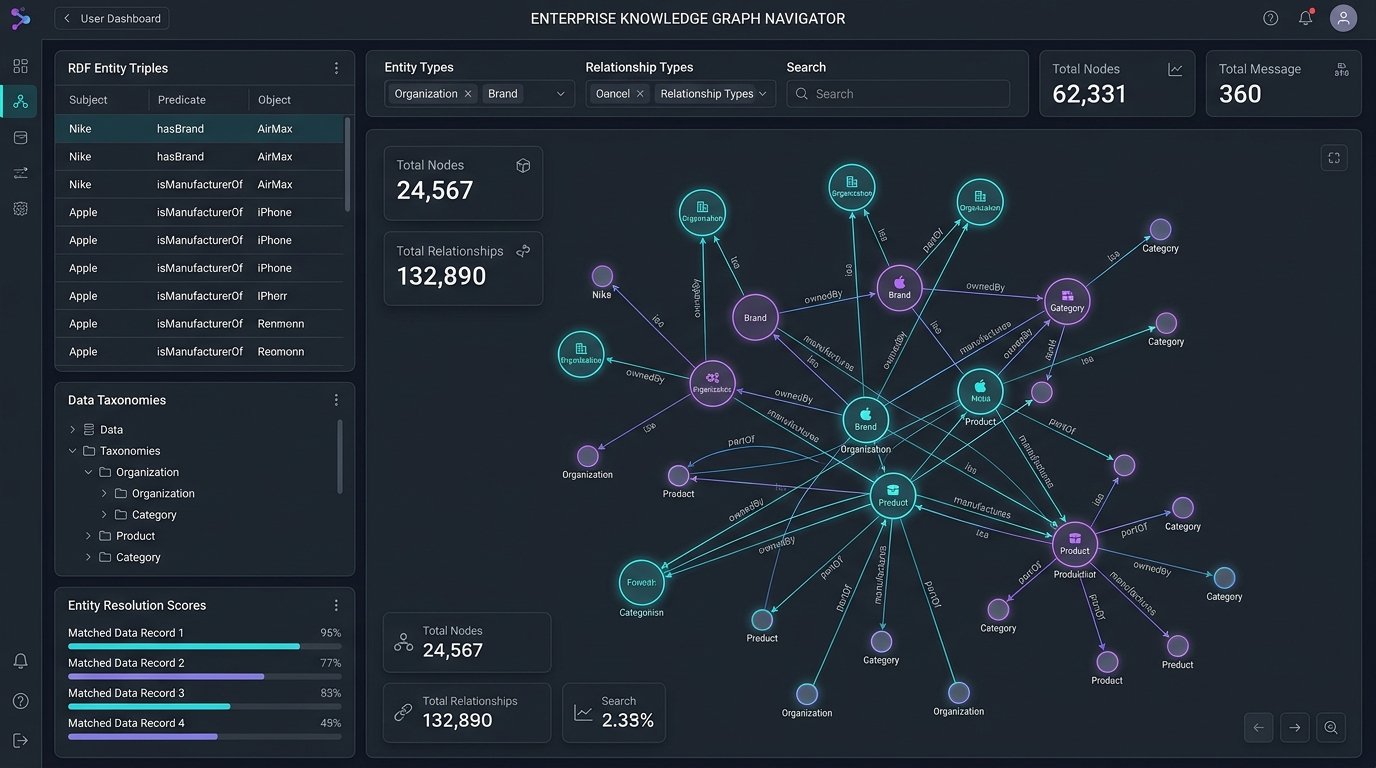
Modern search engines are semantic knowledge engines. Google uses entity recognition to understand real-world concepts, organizations, products, and authors beyond raw text matching. When your enterprise website isolates structured data across separate script tags, search engines cannot establish entity relationships reliably.
Enterprise SEO architecture requires a Tripartite Schema Graph: an interconnected JSON-LD data structure that links your organization entity to your website, professional services, author profiles, and canonical articles using explicit node references.
The Unified JSON-LD @graph Standard
According to Schema.org Data Model standards and Google Search Central structured data documentation, deploying an @graph array allows you to define persistent URIs using @id attributes. Connecting this technical schema with authoritative corporate brand identity design establishes the brand entity in Google Knowledge Graph and primes your content for visibility across LLMs and AI Overviews:
{
  "@context": "https://schema.org",
  "@graph": [
    {
      "@type": "Organization",
      "@id": "https://yantramedia.co.in/#organization",
      "name": "Yantra Media",
      "url": "https://yantramedia.co.in/",
      "logo": "https://yantramedia.co.in/wp-content/uploads/2025/10/Group-129.png",
      "address": {
        "@type": "PostalAddress",
        "streetAddress": "Office No: 771 (Seventh Floor), Gaur City Mall, Greater Noida West",
        "addressLocality": "Greater Noida",
        "addressRegion": "Uttar Pradesh",
        "postalCode": "201318",
        "addressCountry": "IN"
      }
    },
    {
      "@type": "WebSite",
      "@id": "https://yantramedia.co.in/#website",
      "url": "https://yantramedia.co.in/",
      "name": "Yantra Media",
      "publisher": { "@id": "https://yantramedia.co.in/#organization" }
    },
    {
      "@type": "Article",
      "@id": "https://yantramedia.co.in/blog/enterprise-seo-architecture-guide/#article",
      "isPartOf": { "@id": "https://yantramedia.co.in/#website" },
      "headline": "Enterprise SEO Architecture Guide: From Crawl Budget to Knowledge Graph",
      "author": {
        "@type": "Organization",
        "@id": "https://yantramedia.co.in/#organization",
        "name": "Yantra Media Creative Team"
      },
      "publisher": { "@id": "https://yantramedia.co.in/#organization" }
    }
  ]
}
Enterprise Case Teardown: Resolving a 1.2M Facet URL Explosion
To demonstrate the real-world impact of architectural optimization, consider a recent engagement managed by Yantra Media for an enterprise e-commerce catalog featuring 140,000 product SKUs across India. As documented across our verified client feedback records, the client was suffering from acute crawl traps and index bloat.
The Initial Diagnostic
Server access log analysis revealed that Googlebot was making 160,000 requests per day, but 74% of those requests hit faceted filter combinations that returned duplicate or near-duplicate listings. Essential product pages were waiting up to 60 days between crawler visits.
- Total Monthly Requests: 4,800,000 Googlebot hits.
- Waste Vector: 3,552,000 requests burned on multi-attribute filter URLs and sorting queries.
- Valid Indexable Inventory: Only 140,000 unique URLs existed, yet Google had indexed 1,210,000 thin facet URLs.
The Architectural Remediation
Yantra Media deployed a 4-point structural intervention over a 21-day sprint:
- Edge URL Normalization: Deployed edge rules to strip session tokens and enforce strict lowercase parameter ordering.
- Robots.txt Parameter Hardening: Blocked 3-tier facet combinations and sorting parameters, immediately halting bot ingestion of 1,000,000+ junk URLs.
- Conditional HTTP 304 Validation: Configured edge caches to return 304 Not Modified status codes for un-updated product URLs, reducing average server response time from 640ms to 120ms.
- Schema Graph Unification: Replaced standalone schema scripts with a unified JSON-LD @graph, connecting all product categories directly to the root organization node.
The 45-Day Outcome
Within 45 days of deployment, Googlebot requests to low-value facet URLs dropped by 88%. The reclaimed crawl capacity shifted entirely to core category and product pages, increasing organic impressions across Delhi NCR and national markets by 62%.
Enterprise SEO Governance and CI/CD Release Checklist
Enterprise search performance frequently suffers from regression when development teams release software updates without SEO validation. Integrating automated SEO verification gates into your CI/CD pipeline prevents ranking disruptions before code touches production servers.
Pre-Deployment Release Checklist
- Canonical Self-Referencing Check: Verify that staging templates do not render staging URLs inside production canonical tags.
- Robots Header Validation: Confirm that noindex or nofollow meta tags used in pre-production environments are automatically stripped during production deployment.
- HTTP Header Verification: Test that server-side caching returns valid ETag and Last-Modified headers with accurate 304 response codes.
- Redirect Map Integrity: Ensure modified URL structures include direct 301 redirects with zero intermediary hops.
- Schema Graph Validation: Run automated JSON-LD tests to confirm that newly generated templates maintain valid @id cross-node connections.
Frequently Asked Questions
What is enterprise SEO architecture?
Enterprise SEO architecture is the engineering of site infrastructure, taxonomy, and server headers to ensure search bots efficiently discover, crawl, and index websites containing hundreds of thousands of pages. It establishes crawl budget governance, conditional HTTP caching, and knowledge graph schema to sustain long-term organic search optimization across massive digital domains.
How does crawl budget impact enterprise websites?
Crawl budget limits the total number of URLs search engine bots will request from your domain. If an enterprise site has 200,000 pages but Googlebot only crawls 5,000 pages per day due to server latency or crawl traps, essential revenue-generating pages remain unindexed for months.
What is the difference between crawl capacity limit and crawl demand?
Crawl capacity limit is determined by your server infrastructure and responsiveness; faster servers allow more requests without degradation. Crawl demand is determined by page authority, popularity, and update frequency; higher-demand pages prompt bots to visit more frequently.
How do HTTP 304 Not Modified headers conserve crawl budget?
When a bot sends a conditional GET request with an If-Modified-Since header, an HTTP 304 response confirms the content has not changed. The server sends an empty body, consuming negligible compute and bandwidth, which allows the bot to immediately crawl other pending URLs.
Why does faceted navigation create search index bloat?
Faceted filters let users combine sorting, sizing, and pricing attributes. These combinations multiply rapidly, creating millions of low-value, duplicate URL variations that confuse search bots and deplete crawl budget unless blocked or canonicalized.
Should faceted filter combinations be blocked in robots.txt or canonicalized?
High-value facets with proven search demand should have static URLs and be indexed. Low-value facet combinations (such as multi-attribute sorting) must be blocked via robots.txt or disallowed at the link level to physically prevent crawler waste. Canonical tags alone do not stop bots from crawling the URLs.
Why is client-side rendering risky for enterprise SEO?
Client-side JavaScript rendering forces search engines to queue pages for secondary rendering, delaying indexation by days or weeks. Engaging a custom web design agency to implement server-side rendering (SSR) or incremental static regeneration (ISR) delivers immediate, single-pass indexing.
How does a Schema.org @graph array improve Knowledge Graph visibility?
An @graph array consolidates disparate schema entities into a unified knowledge graph. By connecting Organization, WebSite, and Article nodes with unambiguous @id references, search engines verify entity relationships and brand authority with complete clarity.
What is the ideal click depth for enterprise site architecture?
Crucial landing pages should sit within 3 to 4 clicks from the homepage. Deeper nesting reduces internal PageRank distribution and signals to search bots that the nested pages are of low relative priority, diminishing crawl frequency.
How should international enterprises manage multi-regional architecture?
International enterprise architectures must deploy country-code top-level domains (ccTLDs) or subdirectories paired with bidirectional hreflang tags, self-referencing canonicals, and localized schema markup to prevent regional duplicate content cannibalization.
Need a Rigorous Technical SEO Architecture Audit?
Yantra Media’s technical engineering studio eliminates crawl waste, designs sub-2.0s frontend architectures, and builds authoritative knowledge graphs for enterprise brands across India and global markets.