

Google AI Overviews Optimization: 7 Actionable Steps (2026)

- Generative Extraction Vector: AI Overviews extract content based on semantic passage clarity and factual density rather than aggregate domain link authority.
- Information Gain Metric: Search models select pages that contribute novel facts, proprietary data, or unique structured mechanisms missing from baseline corpora.
- Schema Triple Grounding: Unambiguous JSON-LD @graph entities give language models verifiable validation points to synthesize answers without hallucination.
- Markdown & Plain Text Accessibility: Deploying clean markdown alternatives via llms.txt enables rapid ingestion by autonomous research agents and crawler bots.
Google AI Overviews optimization is the process of structuring digital content so Large Language Models retrieve, extract, and cite your domain within generative answer snapshots. Unlike traditional ranking algorithms that prioritize backlink quantities, AI engines evaluate semantic passage relevance, factual density, and verified entity relationships.
According to empirical findings published in the landmark Princeton and Georgia Tech GEO research study, content optimized with factual citations and statistical quotes boosts generative search visibility by up to 40%. At Yantra Media, our technical specialists execute generative engine optimization noida campaigns that engineer high-density information architecture to secure prominent citation placement.
In this technical guide, Yantra Media details the exact retrieval architecture, citation triggers, and markdown structures required to earn repeated references across Google AI Overviews, Perplexity Pro, and emerging conversational search engines.
The Mechanical Shift: How Answer Engines Retrieve and Cite Content
Traditional search engines operate on an inverted index coupled with link graph algorithms. A crawler discovers an HTML page, tokenizes keywords, measures inbound link authority, and positions the URL on a ten-blue-links results page. The user chooses which link to open.
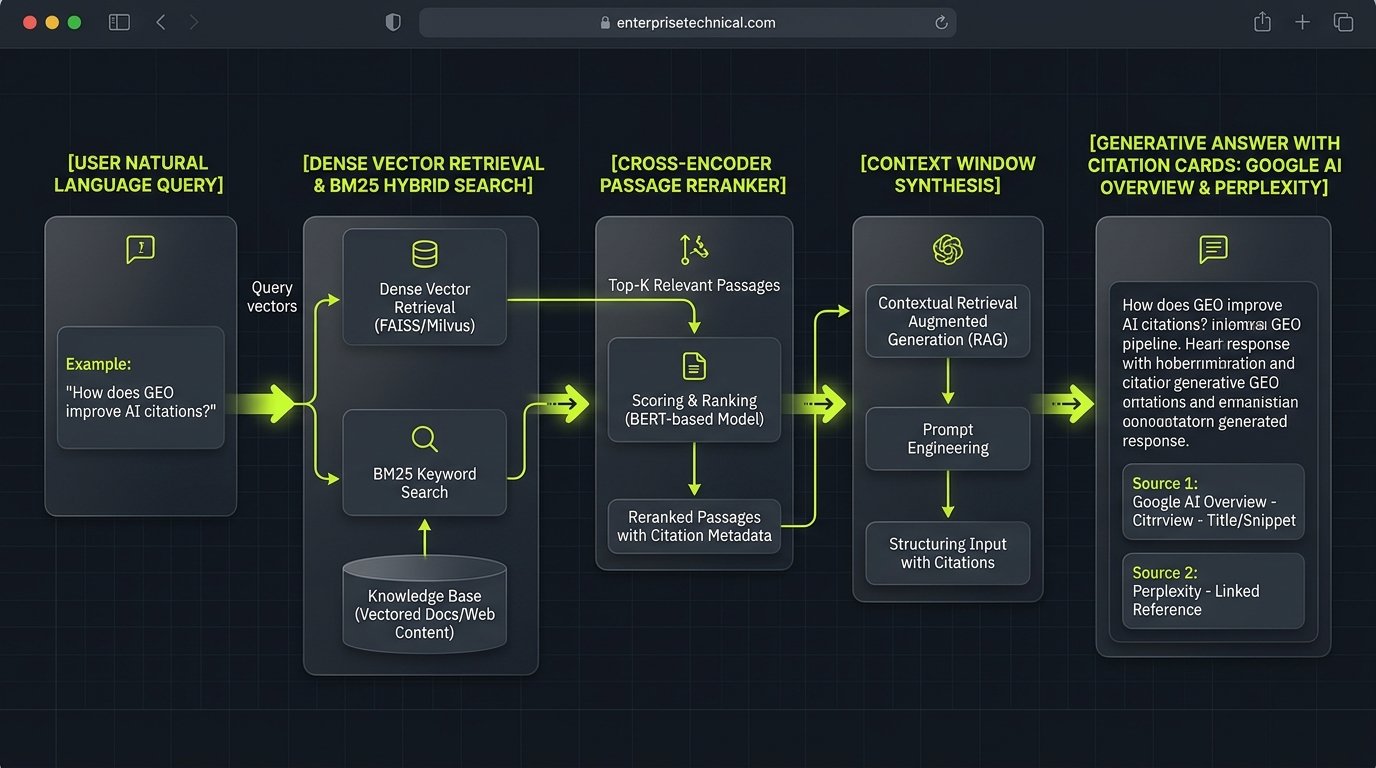
Generative search engines function on a Retrieval-Augmented Generation (RAG) pipeline. Rather than directing users to a document, the system generates an immediate textual answer, decorating the synthesis with hyperlinked source citations. According to official Google Search Central documentation on helpful content, algorithms evaluate whether content provides original information, substantial analysis, and clear sourcing before including it in automated answer surfaces.
Winning placement inside these answer modules requires understanding the four sequential stages of generative retrieval:
- Query Expansion & Semantic Intent Classification: When a user enters a prompt, the system expands the query into multiple sub-queries. It identifies missing entities and formulates internal search vectors.
- Dense Vector Retrieval (Bi-Encoder Phase): The search engine matches query vector embeddings against indexed document passages stored in high-dimensional vector spaces. Keywords alone do not determine inclusion; conceptual semantic alignment governs initial selection.
- Cross-Encoder Reranking & Passage Filtering: The top 50 to 100 candidate chunks pass through a cross-encoder model that scores passage-level coherence, factual accuracy, and context fit. Irrelevant paragraphs are discarded.
- Synthesis Context Window & Source Citation Selection: The final 5 to 10 top-scoring passages enter the LLM’s context window. The model synthesizes the answer and adds hyperlinked footnote chips pointing to the exact URLs whose passages directly informed each claim.
Traditional SEO vs Generative Engine Optimization (GEO)
Understanding how GEO diverges from legacy search optimization clarifies where engineering teams must redirect their efforts:
| Architectural Vector | Traditional Organic Search (SERP) | Generative Engine Optimization (GEO) |
|---|---|---|
| Primary Evaluation Unit | Entire URL / Web Page | 150–300 Word Semantic Text Chunk |
| Primary Ranking Signal | Inbound Domain Authority & PageRank | Information Gain & Factual Density |
| Crawler Consumption Mode | Full HTML Document Parsing | Clean Text, Markdown & JSON-LD Triples |
| User Interaction Model | Click on Title Tag & Read Page | Consume Synthesized Overview & Click Citation |
| Failure Mode | Low SERP Position (Page 2+) | Zero Mention / Excluded from Model Context |
Engineering your content for generative engines requires formatting pages so each subsection functions as an autonomous, self-contained factual chunk that models can extract without contextual confusion.
Passage Engineering: The Format AI Synthesizers Prefer
Large Language Models do not read pages like human browsers. They process token streams. When an AI retrieval pipeline extracts a candidate snippet, it evaluates whether the passage provides a clear, unencumbered answer to the user’s underlying question.
To maximize your inclusion rate in Google AI Overviews and Perplexity summaries, structure each key section using the following rules:
1. The AnsFirst Inverted Pyramid Formulation
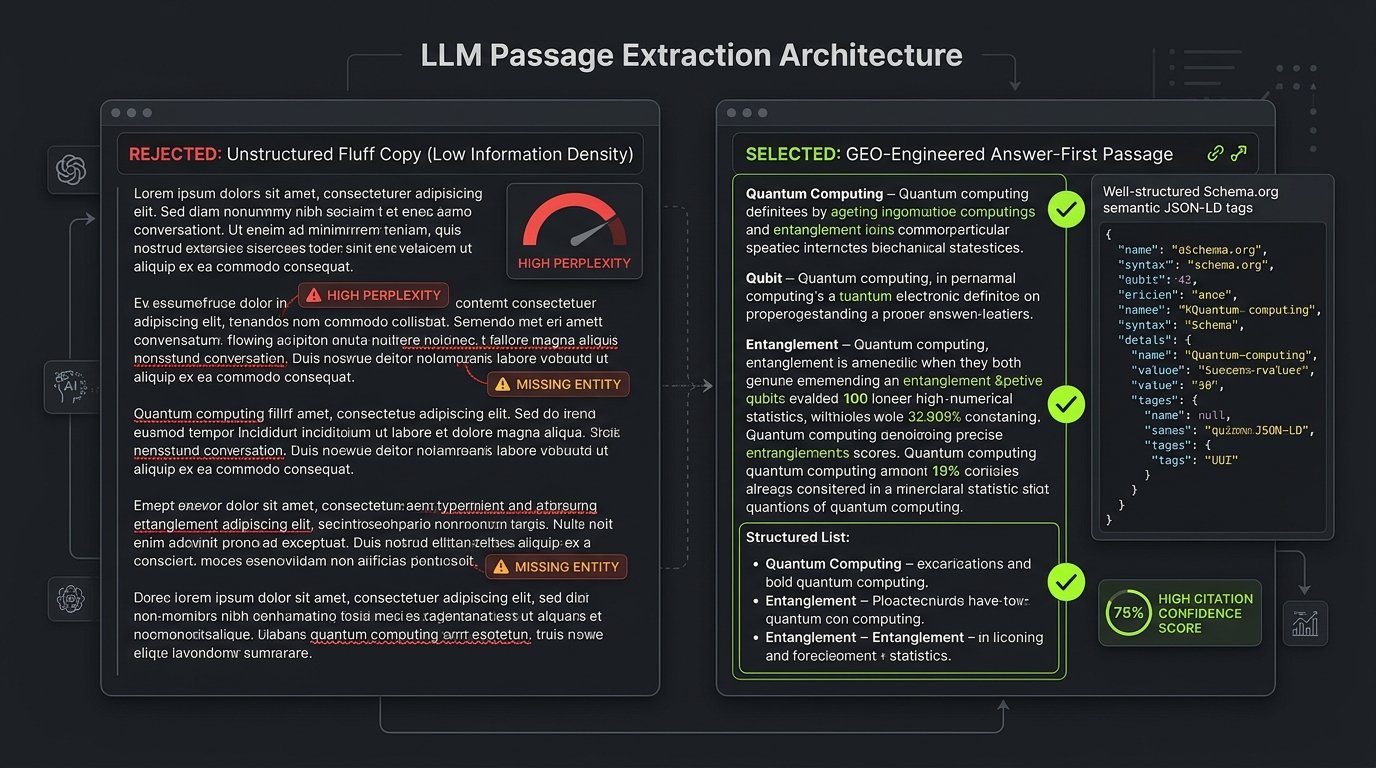
Start every major content section with a 40 to 55-word direct answer paragraph. The opening sentence must define the entity, mechanism, or metric using bold formatting. Follow with the operational causality and supporting parameters. Avoid narrative preamble, introductory pleasantries, or historical background before giving the answer.
2. High Factual Density and Specific Mechanisms
Language models discard fluff copy. Replace abstract adjectives with concrete mechanisms. For example, instead of writing “our platform delivers fast performance,” specify “the platform achieves a 140ms server response time by utilizing Redis object caching and Cloudflare edge workers.” LLMs preferentially cite text containing verifiable metrics, technical protocols, and explicit operational steps.
3. Structured Data Scaffolding (HTML Tables & Definition Lists)
Generative models excel at ingesting tabular and list structures. When presenting comparative criteria, cost ranges, or workflow sequences, use native HTML tables or ordered lists. Tabular formats provide clear key-value relationships that models translate into bulleted syntheses with high attribution accuracy.
4. Banning Negative Parallelism and Predictable AI Cadence
Machine learning models trained on quality filters penalize predictable AI writing tropes. Avoid clichéd rhetorical crutches such as “not only X, but also Y” and symmetrical groups of three generic adjectives. Use direct, asymmetric sentence structures that reflect genuine technical documentation.
Entity Grounding and Knowledge Graph Verification
AI answer engines verify facts against existing knowledge repositories before displaying citations to minimize hallucination risks. If a page makes an assertion that contradicts verified entity data or lacks structured validation, the model downweights the source during the cross-encoder reranking phase.
Securing source trust requires establishing explicit entity connections using Schema.org data model standards. While standard SEO often stops at basic Article schema, GEO demands an interconnected tripartite graph linking Organization, Service, Author, and Subject entities.
By linking the about array to canonical Wikipedia or Wikidata entities via sameAs attributes, you eliminate ambiguity regarding what concept your document defines. When Googlebot or PerplexityBot evaluates the page, the parser connects your proprietary insights directly to established Knowledge Graph nodes.
For enterprise setups with complex multi-service architectures, ensure your root service pages are reinforced with comprehensive enterprise seo services and validated schemas as outlined in our technical organic search optimization architecture.
Technical Primitives: Implementing llms.txt and Clean Markdown Delivery
A major bottleneck for AI retrieval engines is DOM noise. Modern web applications load heavy JavaScript bundles, tracking tags, CSS animations, and complex DOM trees. When autonomous AI research agents crawl websites to answer user queries, parsing bloated HTML wastes computational budget and token limits.
Forward-thinking engineering teams implement machine-readable content mirrors using the emerging llms.txt standard and server-side markdown endpoints:
The llms.txt Specification
Placed at the domain root (https://yantramedia.co.in/llms.txt), this plain text file serves as a curated catalog of your domain’s most authoritative content, structured specifically for LLMs. It outlines your core entity identity, key service URLs, and provides direct links to markdown versions of your technical guides.
Content-Signal & Agent Header Configuration
Ensure your server web headers permit AI agents to crawl and index your site without receiving Cloudflare challenge screens. Inspect your robots.txt file to verify that user agents such as Google-Extended, PerplexityBot, GPTBot, and ClaudeBot are explicitly granted access to your public content directories.
Pairing crawl permissions with high-performance server delivery ensures AI bots fetch your content in milliseconds. If your web assets suffer from latency bottlenecks, conducting a thorough technical seo audit to achieve sub-2.0s core web vitals engineering provides an immediate competitive advantage in retrieval queues.
7 Actionable Steps for Google AI Overviews Optimization
Executing an effective campaign for google ai overviews optimization requires a disciplined technical workflow that bridges traditional crawl accessibility with generative AI passage synthesis:
- Audit Target Query Overviews: Search your high-priority transactional keywords to map whether Google displays an AI Overview or generative snapshot. Note the top 3 cited reference sources and identify their passage structure.
- Identify Information Deficits: Locate the specific data points, cost figures, or architectural parameters that competitor sources overlook. Introducing verified empirical metrics creates instant information gain.
- Structure 45-Word Answer Blocks: Lead every major subheading with a concise 45-word direct answer that solves the search query before presenting detailed explanations.
- Inject Tripartite Entity Schemas: Implement Schema.org JSON-LD structured data linking your author profiles, corporate entity, and core services via canonical Knowledge Graph identifiers.
- Establish Multi-Source Brand Corroboration: Validate your claims across authoritative third-party directories, technical journals, and verified client feedback records to build cross-platform verification.
- Deploy an llms.txt Index: Host a clean plain-text directory at your root domain to facilitate lightweight token extraction by autonomous agent crawlers.
- Monitor Continuous Retrieval Telemetry: Track brand citations across Google AI Overviews, Perplexity Pro, and ChatGPT Search on a bi-weekly cadence to refine your content architecture.
If your organization wants to establish search dominance in both traditional SERPs and generative AI engines, collaborating with the best seo agency in noida ensures your web infrastructure is engineered for maximum algorithmic trust. When scaling your visual branding across digital touchpoints, our corporate brand identity design team builds cohesive design systems that reinforce brand prominence.
Frequently Asked Questions (PAA & AI Citation Ready)
What is Generative Engine Optimization (GEO)?
Generative Engine Optimization (GEO) is the practice of optimizing digital content and technical architecture so Large Language Models retrieve, extract, and reference your website within AI-generated answer summaries. While traditional SEO focuses on keyword ranking in search result lists, GEO focuses on citation rate, semantic passage clarity, and factual inclusion inside engines like Google AI Overviews, Perplexity, and ChatGPT Search.
How does Google select sources for AI Overviews?
Google selects sources for AI Overviews through a multi-stage retrieval-augmented pipeline. The algorithm first performs dense vector retrieval to identify passages with high conceptual similarity to the user’s intent. Next, cross-encoder models score candidate chunks for factual consistency, authoritative entity backing, and information gain. Passages that directly answer the query with concrete metrics and clear schema markup are synthesized into the summary, accompanied by linked citation chips.
What is the difference between SEO and GEO?
The fundamental difference between SEO and GEO lies in the evaluation unit and destination format. Traditional SEO optimizes entire URLs for keyword placement and PageRank authority to drive clicks to web pages. GEO optimizes granular 150 to 300-word passages for semantic clarity, structured data density, and factual uniqueness to earn attribution within direct conversational answers generated by AI synthesizers.
How can a website earn citations on Perplexity AI?
To earn citations on Perplexity AI, pages must provide direct answers in the opening 50 words of each section, include structured tables with comparative data, and maintain clear entity connections. Perplexity values clean markdown formatting, verified external citations, and fast server response times. Ensuring that PerplexityBot is permitted in your robots.txt file and offering an llms.txt plain text directory significantly boosts citation frequency.
Does schema markup help with AI search rankings?
Yes, Schema.org JSON-LD structured data is essential for AI search visibility. Large Language Models rely on structured graphs to disambiguate corporate entities, verify subject matter taxonomies, and confirm author expertise. Using interconnected @graph arrays that link Organization, WebSite, Service, and Article nodes gives AI evaluators verifiable factual triples that reduce model uncertainty and increase citation confidence.
What is the purpose of an llms.txt file in modern SEO?
The llms.txt file is an emerging web standard that provides a curated, plain-text markdown summary of a domain’s core capabilities and authoritative content specifically for LLMs. By providing content free from navigation menus, tracking scripts, and complex HTML layouts, llms.txt enables AI research agents to ingest your key frameworks and data models with minimal token consumption, accelerating citation inclusion.
Optimize Your Digital Architecture for the Next Era of Search
Search is shifting from document discovery to synthesized intelligence. Win AI Overviews and Perplexity citations with high-density passage formatting, sub-2.0s speed, and unified schema graphs engineered by Yantra Media.