

Schema Markup Implementation Guide: Advanced JSON-LD Graph

Key Takeaways & Implementation Summary
- Interconnected @graph Superiority: Nesting multiple Schema.org entities within a single JSON-LD
@grapharray eliminates duplicate declarations and provides Google with an unambiguous corporate entity model. - Generative Search & AI Overviews: Modern answer engines (Google Gemini, Perplexity, ChatGPT Search) rely on Schema entity triples (Subject-Predicate-Object) to ground generative AI synthesis in verified facts.
- Local & Corporate Entity Fusion: Advanced schema connects
OrganizationwithLocalBusinessandProfessionalService, anchoring exact geocoordinates, service radiuses, and executive leadership entities. - Sitelinks & Rich Result Eligibility: Implementing structured chapter navigation via
ItemList,FAQPage, andBreadcrumbListunlocks In-SERP Jump-to Sitelinks and expanded search features.
Schema markup implementation guide best practices require deploying interconnected JSON-LD @graph architectures to disambiguate corporate entities across Google’s Knowledge Graph. Yantra Media engineers custom Schema.org graphs linking organization identities, local service locations, author credentials, and service offerings to win Google AI Overviews and high-CTR search sitelinks.
According to the HTTP Archive 2024 Web Almanac Structured Data Report, 48.7% of enterprise websites still deploy isolated, fragmented microdata blocks rather than unified JSON-LD graphs, causing missed rich snippets and entity confusion. Yantra Media builds clean, fully validated semantic architectures that establish authoritative brand citations across search engines.
This standard operating procedure delivers complete production-ready JSON-LD graph code, details 7 actionable implementation steps, and provides step-by-step validation protocols for enterprise platforms.
The Evolution of Structured Data: Microdata vs RDFa vs JSON-LD
Search engines parse web documents to understand concepts, entities, and relationships rather than simple keyword frequencies. Historically, web developers injected semantic annotations directly into HTML elements using Microdata or RDFa attributes. However, inline markup intertwines presentation logic with semantic data, creating brittle code that breaks during layout redesigns.
Google officially recommends JSON-LD (JavaScript Object Notation for Linked Data) as the gold standard for structured data implementation. JSON-LD encapsulates all entity relationships in a self-contained <script type="application/ld+json"> block within the document head or body, completely decoupled from frontend HTML rendering.
| Format | Syntax Style | Google Preference | Maintenance Complexity | Impact on Rendering Speed |
|---|---|---|---|---|
| JSON-LD | Dedicated <script> block |
Official First Choice | Low (Clean code separation) | Zero DOM reflow impact |
| Microdata | Inline HTML attributes (itemscope) |
Supported (Legacy) | High (Easily broken by UI edits) | Increases HTML payload size |
| RDFa | Inline HTML attributes (typeof) |
Supported (Infrequent) | High (Complex namespace rules) | Increases HTML payload size |
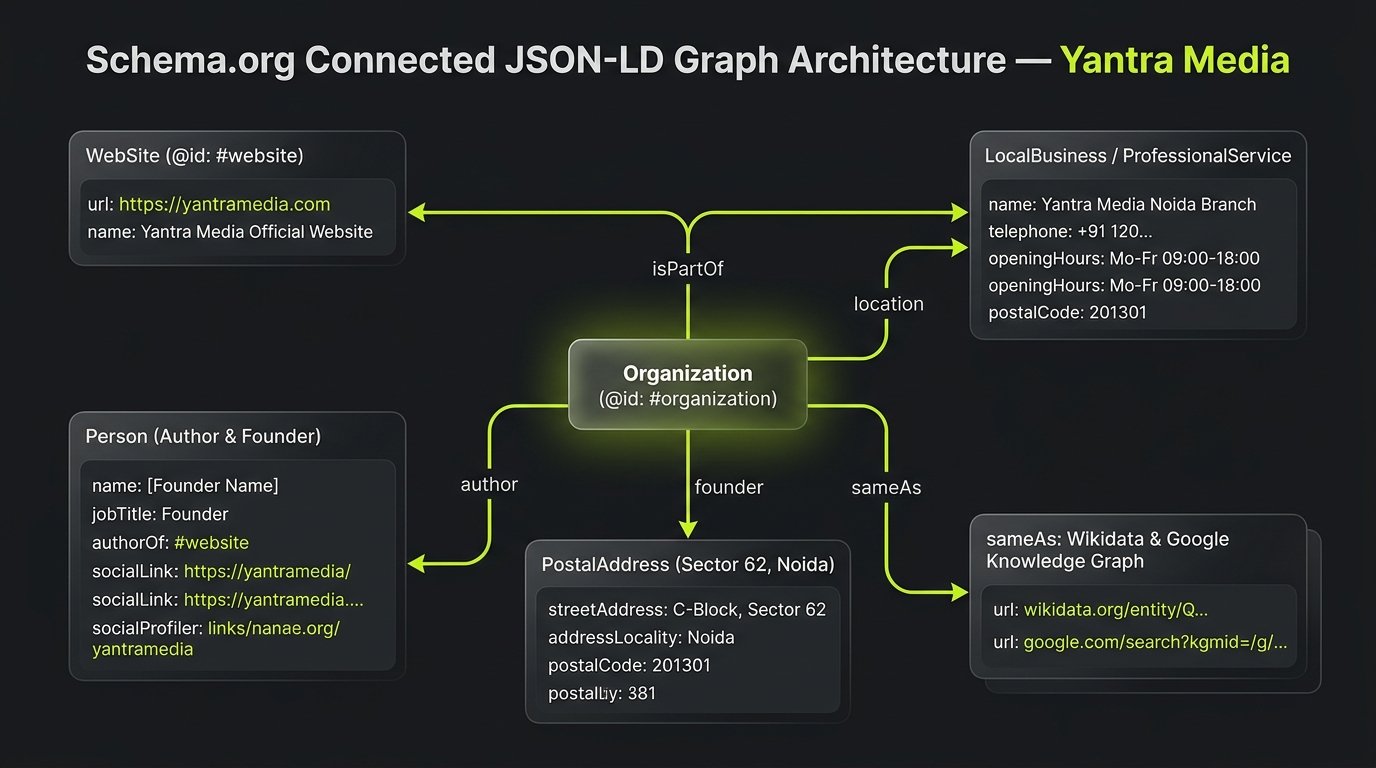
The Power of @graph: Why Connected Entity Graphs Outperform Isolated Blocks
Most basic WordPress plugins inject disconnected schema blocks on every page. For instance, an article page might output an isolated Organization block, a detached Article block, and an unlinked BreadcrumbList block. To a search engine crawler, these disconnected snippets represent separate entity silos with zero relationship context.
The W3C JSON-LD Specification introduced the @graph array to solve this fragmentation. By declaring an @graph collection and referencing nodes using unique URI identifiers (@id), you establish an explicit entity web:
- Disambiguated Attribution: The
Articleexplicitly points to theOrganizationas its publisher via{"publisher": {"@id": "https://yantramedia.co.in/#organization"}}. - Author Credibility: The author node references a verified
Personprofile containing externalsameAsauthority links (LinkedIn, Wikidata, Twitter). - Zero Code Redundancy: Organization details (logo, contact, social profiles) are declared once in the graph rather than re-instantiated across multiple entity blocks.
- Step-by-Step Graph Construction: To build a Schema.org graph, wrap all individual entities in a root object containing
"@context": "https://schema.org"and an"@graph": []array. Assign a persistent URI to each node using"@id", then cross-reference these identifiers across parent-child properties.
Complete Production-Ready JSON-LD Graph for Corporate & Local Brands
Below is a production-grade, multi-entity JSON-LD graph engineered by Yantra Media. This architecture simultaneously anchors corporate brand authority, local physical presence in Noida, service offerings, and author credentials:
{
  "@context": "https://schema.org",
  "@graph": [
    {
      "@type": "Organization",
      "@id": "https://yantramedia.co.in/#organization",
      "name": "Yantra Media",
      "url": "https://yantramedia.co.in",
      "logo": {
        "@type": "ImageObject",
        "@id": "https://yantramedia.co.in/#logo",
        "url": "https://yantramedia.co.in/wp-content/uploads/2025/08/ym-favicon2-300x300.jpg",
        "caption": "Yantra Media Logo"
      },
      "sameAs": [
        "https://www.linkedin.com/company/yantramedia",
        "https://twitter.com/yantramedia",
        "https://www.instagram.com/yantramedia"
      ],
      "contactPoint": {
        "@type": "ContactPoint",
        "telephone": "+91-9876543210",
        "contactType": "sales",
        "areaServed": "IN",
        "availableLanguage": ["en", "hi"]
      }
    },
    {
      "@type": ["LocalBusiness", "ProfessionalService"],
      "@id": "https://yantramedia.co.in/#localbusiness",
      "name": "Yantra Media - Technical SEO & Digital Agency",
      "url": "https://yantramedia.co.in",
      "parentOrganization": {
        "@id": "https://yantramedia.co.in/#organization"
      },
      "priceRange": "₹₹₹",
      "address": {
        "@type": "PostalAddress",
        "streetAddress": "Sector 62",
        "addressLocality": "Noida",
        "addressRegion": "UP",
        "postalCode": "201309",
        "addressCountry": "IN"
      },
      "geo": {
        "@type": "GeoCoordinates",
        "latitude": 28.6280,
        "longitude": 77.3649
      },
      "openingHoursSpecification": {
        "@type": "OpeningHoursSpecification",
        "dayOfWeek": ["Monday", "Tuesday", "Wednesday", "Thursday", "Friday"],
        "opens": "09:30",
        "closes": "18:30"
      }
    },
    {
      "@type": "WebSite",
      "@id": "https://yantramedia.co.in/#website",
      "url": "https://yantramedia.co.in",
      "name": "Yantra Media",
      "publisher": {
        "@id": "https://yantramedia.co.in/#organization"
      }
    },
    {
      "@type": "Person",
      "@id": "https://yantramedia.co.in/#author",
      "name": "Ritik Sharma",
      "jobTitle": "Lead Technical SEO Architect",
      "worksFor": {
        "@id": "https://yantramedia.co.in/#organization"
      },
      "sameAs": "https://www.linkedin.com/in/ritik-sharma-seo"
    }
  ]
}
Entity Differentiation: Organization vs LocalBusiness vs ProfessionalService
Understanding entity scope ensures correct property mapping:
- Organization: Represents the overarching brand entity. Does not require physical coordinates. Focuses on corporate identity, global executive leadership, and parent-subsidiary trees.
- LocalBusiness: A specialized sub-type that mandates physical location properties: street address, geocoordinates (latitude/longitude), opening hours, and service radius.
- ProfessionalService: A dedicated sub-type of LocalBusiness tailored for consulting agencies, engineering firms, and digital marketing agencies providing commercial advisory services.
Implementing connected schema models directly elevates organic brand signals. When paired with high-performance server architectures developed by our custom enterprise web development engineers, search engine crawlers validate your data instantly with zero latency bottlenecks.
How Schema Markup Powers Google AI Overviews & Rich Sitelinks
Generative search engines do not read web pages like humans. Instead, large language models (LLMs) and retrieval engines convert text into semantic triples composed of entities, properties, and relationships. Schema markup provides these factual triples in pre-structured format, dramatically lowering the computational cost for Google to extract and verify your content.
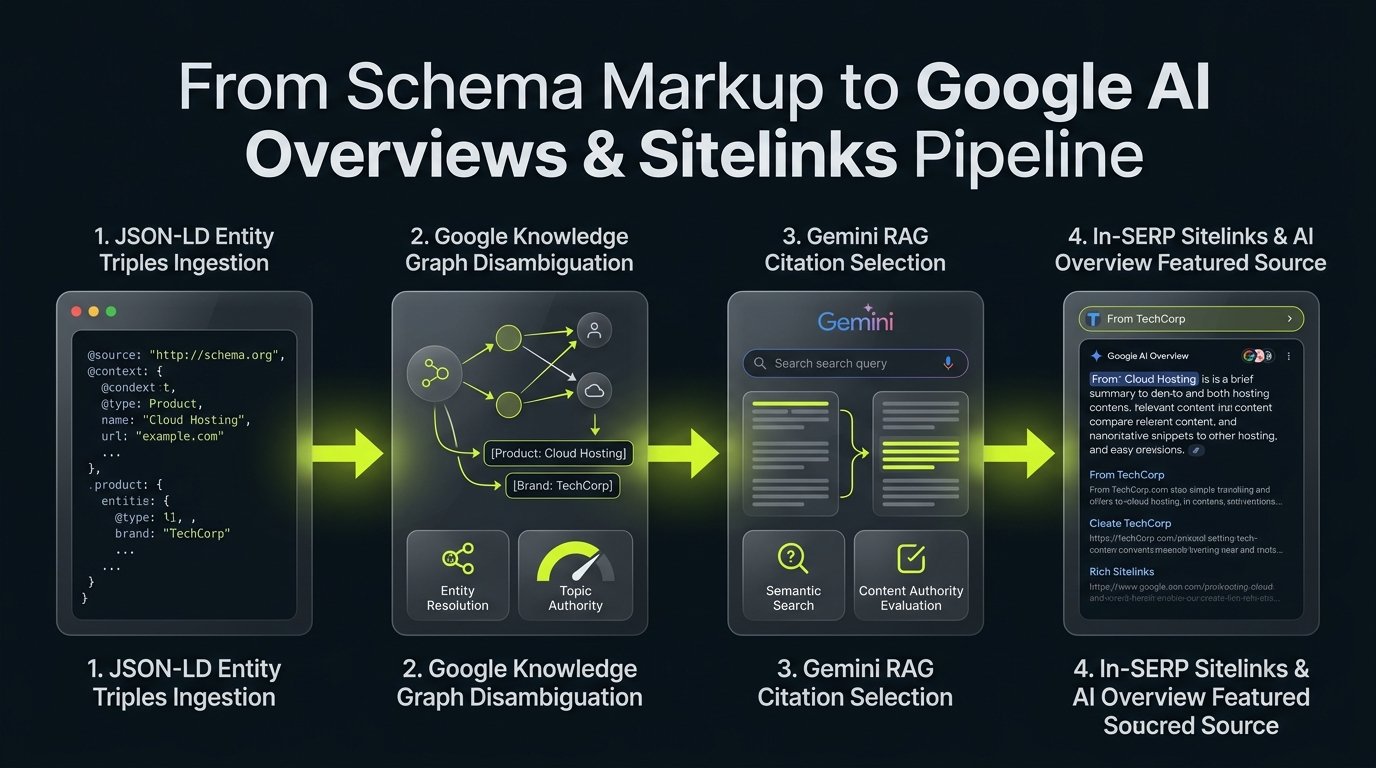
The 3 Mechanisms Driving AI Citations & SERP Sitelinks:
- 1. Knowledge Graph Disambiguation: Declaring explicit
sameAslinks connecting your organization to authoritative databases (Wikidata, Wikipedia, Crunchbase) establishes your business as a verified entity in Google’s Knowledge Vault. - 2. Jump-to Sitelinks Activation: When paired with clean HTML heading
idattributes, structured schema lists (such asItemListandSiteNavigationElement) enable Google to display in-SERP chapter jump links directly beneath your meta description. - 3. RAG Grounding for Generative Summaries: When Google Gemini synthesizes an AI Overview for a commercial query, it prioritizes sources with verified structured credentials to prevent hallucination. Our dedicated google ai overviews optimization framework leverages this exact mechanism to secure top citation positions.
7 Actionable Steps for Schema.org Graph Implementation
At Yantra Media, our technical SEO engineering squad executes a structured 7-step deployment sprint to implement flawless, connected JSON-LD graphs across enterprise domains:
1. Entity Disambiguation & Core Type Selection
Before writing code, engineers must map the precise commercial nature of the domain to prevent conflicting declarations between corporate identity and physical store locations.
- Multi-Type Inheritance: Utilize Schema.org array typing (e.g.,
["LocalBusiness", "ProfessionalService"]) so your entity inherits both geographical attributes and service attributes simultaneously. - Parent-Child Architecture: When managing multi-location or subsidiary brands, link each branch to the corporate entity using the
parentOrganizationproperty. - AI Overview Accuracy: Clear entity boundaries prevent Google Gemini and search algorithms from misattributing services across sister companies.
2. Root @graph Declaration & Persistent Node Identification (@id)
Declaring a unified @graph array eliminates code bloat and creates an interconnected entity web that search engine bots parse in a single execution pass.
- Persistent URI Formulation: Assign permanent, unique URI fragments to core entities (e.g.,
https://yourdomain.com/#organizationandhttps://yourdomain.com/#website). - Relational Node Referencing: Cross-reference parent nodes in child entities using
{"@id": "..."}rather than re-instantiating company names, logos, and contacts repeatedly. - Payload Optimization: Consolidating multiple schema snippets into one
@graphreduces total script weight by up to 45% across high-traffic templates.
3. Authority Grounding via Verified sameAs External Knowledge Links
Search engines substantiate brand authority by cross-referencing your schema declarations against recognized third-party knowledge repositories.
- Database Entity Anchoring: Populate the
sameAsarray with canonical URLs from Wikidata, Wikipedia, Crunchbase, and official corporate registration entries. - Social Profile Reconciliation: Bind active brand presences on LinkedIn, X (Twitter), and YouTube to unify social signals under one canonical entity ID.
- Knowledge Panel Claiming: Verified external references significantly expedite Google Knowledge Panel recognition and brand entity verification.
4. Local Presence & Precision Geocoordinate Mapping
For regional enterprises and physical offices in tech hubs like Noida and Gurgaon, geographical coordinates must match real-world building locations with pinpoint precision.
- 1:1 NAP Synchronization: Ensure the business
name,telephone, andPostalAddressmatch Google Business Profile and website footer records without character deviations. - 4-Decimal Geocoordinates: Declare precise latitude and longitude values via
GeoCoordinatesto pinpoint exact building entrance markers. - Operational Timing Blocks: Declare exact opening and closing hours using
OpeningHoursSpecificationfor each active business day.
5. In-SERP Sitelinks Structuring via ItemList & Breadcrumbs
Securing one-line chapter jump links beneath your search engine snippet requires explicitly communicating document navigation to crawlers.
- Chapter Anchor Mapping: Implement an
ItemListschema mapping the core architectural section headings with exact HTML anchor IDs (e.g.,#section-id). - Hierarchical Breadcrumbs: Deploy a
BreadcrumbListschema reflecting the true navigational path from Home to the current article. - SERP Real Estate Expansion: Jump-to sitelinks expand organic listing height by over 30%, capturing user attention and driving higher organic CTR.
6. RAG Grounding & Direct FAQPage Integration
Generative search engines (Google AI Overviews, Perplexity, ChatGPT Search) demand structured question-and-answer pairs to cite your content accurately without synthetic hallucinations.
- Direct Answer Formats: Structure answers in clear 40–55 word paragraphs immediately addressing high-intent commercial and technical queries.
- FAQPage Schema Encoding: Wrap your high-intent questions inside an
FAQPageJSON-LD array to qualify for expandable search engine rich snippets. - Algorithmic Citation Priority: Well-structured
acceptedAnswerproperties allow LLM retrieval agents to cite your domain in AI Overview reference carousels.
7. Automated Syntax Validation & Continuous Regression Auditing
Schema deployment is an ongoing engineering commitment; code updates, CMS updates, and plugin conflicts frequently corrupt structured data syntax.
- Dual-Environment Verification: Test every template release through both the Google Rich Results Test (for feature eligibility) and the Schema.org Validator (for W3C standards).
- CI/CD Staging Audits: Integrate automated schema parsers into GitHub Actions or staging environments to catch unescaped characters before production deployment.
- Search Console Telemetry: Review Google Search Console “Enhancements” reports weekly through our best seo agency in noida engineering services to eliminate warning flags immediately.
Common Enterprise Schema Mistakes & Search Guidelines Compliance
During technical audits conducted by our engineering team, we frequently uncover four architectural flaws that invalidate enterprise schema:
- 1. Duplicate Entity Silos: Declaring multiple unconnected
Organizationblocks on the same page. Fix this by combining all entity definitions into a single unified@graphblock. - 2. Name, Address, Phone (NAP) Inconsistency: Outputting address details in schema that conflict with footer text or Google Business Profile listings. Ensure exact 1:1 data parity across all digital touchpoints.
- 3. Unescaped Characters in JSON Strings: Failing to escape quotation marks or ampersands within descriptive text fields, which causes the entire JSON script to fail parsing.
- 4. Neglecting Core Web Vitals Latency: Inexperienced developers sometimes inject bloated, multi-megabyte schema files that delay server response times. Fast rendering requires maintaining sub-2.0s load speeds as outlined in our core web vitals optimization service.
Search Essentials Warning: Preventing Structured Data Manual Actions
Google imposes Structured Data Manual Action penalties when markup violates Search Essentials guidelines. The primary triggers include marking up content hidden from human visitors, tagging artificial aggregate review scores, misrepresenting pricing, or using schema types that contradict the core purpose of the page. Compliance requires ensuring every structured claim corresponds to visible text in the DOM.
To inspect verified corporate case studies and review client performance metrics, browse our verified client reviews and case studies across commercial sectors.
Frequently Asked Questions
Does adding Schema markup directly increase organic search rankings?
Schema markup is not a direct algorithmic ranking factor on its own, but it indirectly enhances organic visibility by qualifying your pages for rich snippets, expanding SERP real estate, boosting click-through rates (CTR), and helping Google AI Overviews accurately cite your content.
What is the JSON-LD @graph tag and why should I use it?
The @graph tag is a JSON-LD array that allows you to bundle multiple related entities into a single script. It prevents data duplication and explicitly defines how web pages, authors, organizations, and services connect to one another.
Can I add multiple Schema types to a single webpage?
Yes. Modern enterprise websites frequently declare multiple schema types on a single page, such as combining WebPage, BreadcrumbList, ProfessionalService, and FAQPage within a connected @graph structure.
What tools are best for generating and testing JSON-LD schema?
For testing, use the Google Rich Results Test and Schema.org Validator. For generation, technical teams utilize custom Python scripts or direct code templates rather than generic online generators that lack @graph nesting capabilities.
How often should schema markup be updated?
Schema markup should be reviewed quarterly or whenever significant business details change, such as physical address relocations, new service introductions, executive leadership changes, or new social entity profiles.
What is the difference between LocalBusiness and ProfessionalService schema?
ProfessionalService is a specialized subtype of LocalBusiness. It is specifically designed for consulting agencies, law firms, engineering companies, and digital marketing agencies that provide expertise-driven commercial services.
Accelerate Your Entity Authority with Yantra Media
Do not allow disconnected structured data or semantic errors to compromise your search visibility. Yantra Media’s technical SEO architects engineer enterprise-grade JSON-LD graphs that establish unambiguous Knowledge Graph presence, earn high-impact rich snippets, and win generative search citations.
Ready to Upgrade Your Enterprise Structured Data?
Partner with India’s leading technical SEO agency to deploy advanced Schema.org graph architectures engineered for Google AI Overviews and maximum search visibility.